
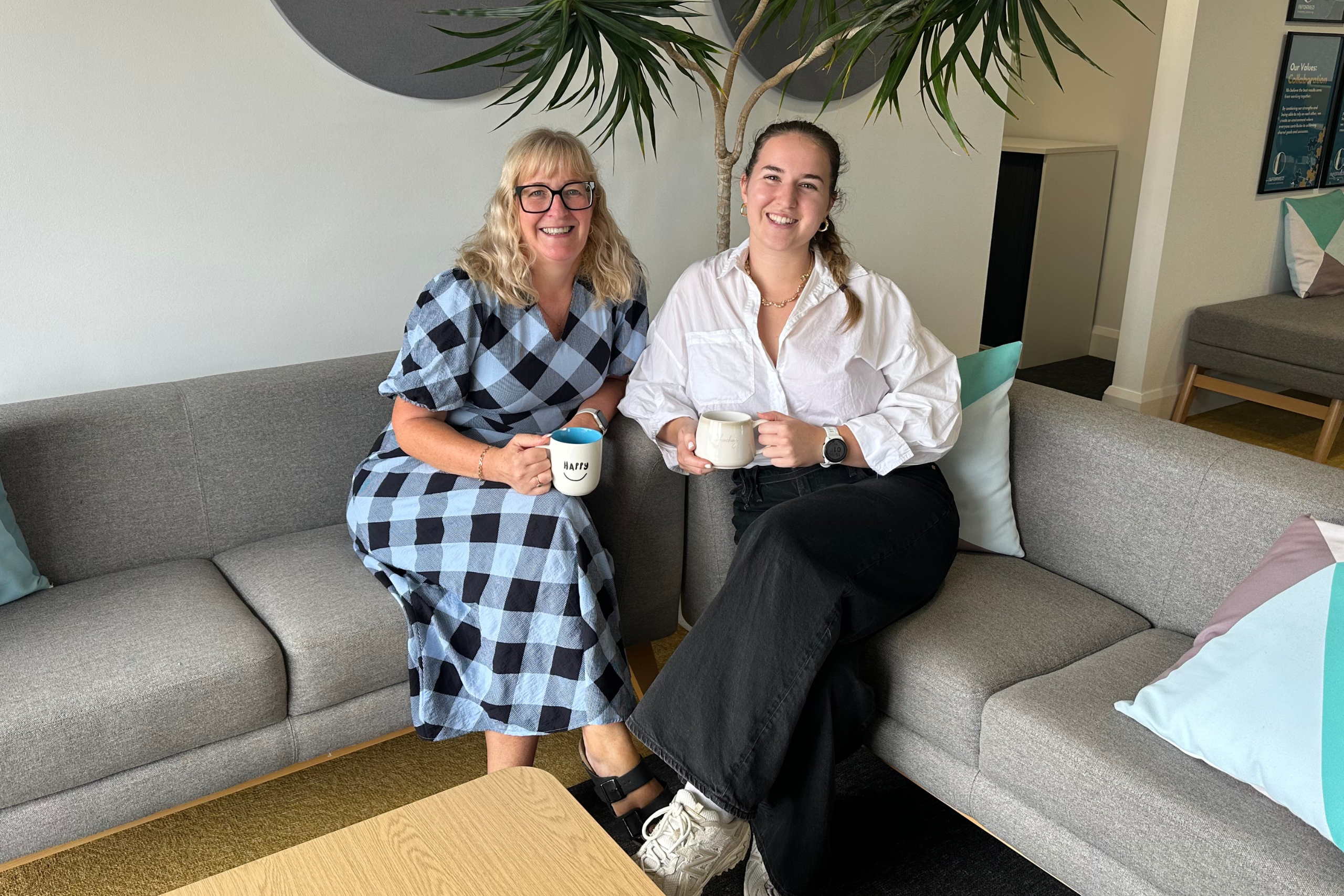
Welcome back to Inside IFP – the series where I sit down with members of our team over a coffee and chat about their career journey. This week I grabbed a drink with Anj! We discussed her career, her passion for education and why, in her words, bringing your “spark” to IFP matters.
Anj, I think you may be the most mentioned person so far throughout these interviews! But we haven’t actually heard you story yet. So, what did you do before joining IFP and how did you end up here?
If we go right back to the beginning, I’ve done lots of things. I worked for a University, I worked in a supermarket in customer service, I worked in payroll; I’ve done all sorts.
When my children were very young, I worked in Safeway in the evenings because I wanted to bring them up. I believed I could have the biggest impact on them and that was my focus, so I did that for 8 years. Then at my leaving do, one of my friends brought her sister-in-law and coincidentally, her husband was a Financial Adviser looking for somebody. I called him on the Monday morning, and he offered me a job!
And that was at IFP?
No it wasn’t, it was another IFA firm that I worked at for 12 years and that served me really well. I did some of my earlier exams there and they were really flexible with my hours for childcare. And that’s one of the things I’ve brought forward to IFP; I believe you can get some really good people if you give that flexibility in working.
I started here 11 years ago as a Practice Manager. When I started there were only 13 of us in the business; it was a lot smaller than it is now. In the early stages, I was responsible for every department, excluding Advisers.
I thought that might’ve been the case because a lot of people have mentioned you when reflecting on their career journey.
I did everybody’s one-to-ones and development plans and created the teams, restructured when we created the Client Services team. I came up with the idea of having dedicated a CS to each Adviser; before it was just general admin.
So how did you end up in compliance?
That’s a long story! We’d been trying to recruit a Compliance Manager and we had lots of interviews, but we just couldn’t get the right person. We recruited two, but neither of them lasted. Nobody seemed to be aligned with the business and what we wanted, and we were struggling so much. I just said “Oh, I’ll do it. It can’t be that hard!”. I had no experience and no qualifications, so I took it on and did my CISI Level 6. Three exams in one year and by the end of it I said “Right, I’m ready”. That would be 7 years ago now!
And then a couple of years later you became Director of Compliance. That’s a great progression! Do you think there were any particular moments or opportunities that helped shape your career journey?
I don’t think there was a particular opportunity; I think it was just a natural happening. At the time, I was working closely with Kev because we didn’t have a full management team. I was Practice Manager and he was Managing Director. That’s when we built the management team, added more people and looked to the team leaders for people to shine and come up to the next level. Gradually it’s just morphed as the business has grown.
IFP is always moving, changing and developing. As a Board, we’ve never been satisfied and we always want more. We’re all competitive, ambitious and enthusiastic. We can’t help but think of an idea and run with it! It’s the way the business has always been and I’ve always wanted to be a part of that.
You’ve got to give yourself some credit for your willingness to put yourself forward, too!
I’ve just always been like that. If something’s needed, I’ll just do it – I’ve always been a doer. I’ve always been one to just get on and do.
Compliance has a bit of a reputation for being all about rules and telling people what they can’t do. Have you found your role to be like that?
I like to think I bring a slightly different perspective to compliance. For me, it’s not about finding reasons to say no, it’s about helping people find a compliant way to achieve what they’re trying to do.
Of course, there are occasions where something isn’t appropriate or doesn’t meet regulatory requirements, but more often than not the conversation is about finding an alternative approach that delivers a good outcome for the client while remaining within the appropriate framework.
One of the things that makes that easier at Informed is the culture we have built over the years. People genuinely care about doing the right thing for clients, and that mindset is embedded throughout the business. When the starting point is always “what is the right thing to do?”, many compliance decisions become much more straightforward.
If there is one lesson I’ve learned over the years, it’s the value of having conversations early. Sometimes people spend time developing a solution only to discover later that there are concerns which could have been addressed at the outset. I always encourage colleagues to ask the question sooner rather than later.
Compliance works best when it is collaborative. The earlier we can discuss an idea, the easier it is to find a solution that works for everyone, especially the client.
One thing that keeps coming up in these interviews is the training that you do. Joe spoke about you running workshops with the Client Services team, Elaine talked about how you helped her through her exams. Do you think those training sessions are one of the things that has helped ingrain everything you just mentioned?
Yeah, I think so. When I started at the other IFA firm, I had no qualifications and there was no opportunity to get them. It wasn’t, “we want you to do this”, but I’m the type of person who has a thirst for knowledge and I wanted to learn and understand what was going on and how I could be better at what I was doing. I asked if they’d mind and they supported me through them, so I did six exams in 2 years with two young children because I loved it and I had a passion for it.
That’s one thing I am passionate about – knowledge. Not just having it myself, but I want to see other people understand the benefits of having that knowledge and where it can take them. When I say to others here that I started as an administrator and just because I was curious, it’s brought me to where I am today. They can all achieve that, so many of them I do believe could have the same path if they wanted it.
I’ve heard people saying that you must’ve been a teacher in another life.
I did consider it when I was younger, but I’m not really a patient person. While I’m doing the workshops, it’s more of a group discussion, I’m not actually teaching the subject. I’m doing the explanation behind the technical side of it and how they need to think and apply it to their role.
So you’re almost just facilitating the learning?
Yeah, that’s the gap between the technical workbook and how it affects clients and bringing them together. That’s the joy that knowledge gives me, and I just want to see all of them embrace that. Some do and some don’t, but it’s one of the things that gives me the greatest pleasure.
One of the other people that mentioned you was Lewis. He said how honest conversations with you helped him think differently about his career. Why is supporting other people something that’s so important to you?
Throughout my career I’ve been fortunate to receive support, guidance and encouragement from colleagues and mentors, and that has shaped the way I approach leadership today.
Financial services is fundamentally a people business and none of us succeeds entirely on our own. I’ve always believed that part of my role is to help others identify their strengths, develop their skills and build a career that is right for them.
Lewis is a great example of that. Through open and honest conversations about his development, we worked together to create a plan for his future. What became clear during that process was that the path I initially saw for him wasn’t necessarily the one he wanted for himself. While that wasn’t the outcome I had expected, it was the right outcome for him.
That experience reinforced an important lesson for me: supporting people isn’t about directing them towards your vision of success, it’s about helping them discover their own.
Having benefited from that kind of support myself throughout my career, I feel a responsibility to provide the same opportunities and encouragement for others. Seeing people grow in confidence and achieve their own goals is one of the most rewarding aspects of leadership.
Is that one of the things that makes you proud to work here?
There’s a lot of things that make me proud to work here. I think it’s the people and seeing where they started and where they’ve come. For example, Lauren T – I was at the beginning of her journey. She came in as work experience for a week and I spotted that talent and I wanted it, so I was reaching out to her and nurturing that relationship and look where she is now! Those are the things that make me feel proud. Not what I’ve achieved.
You’ve mentioned your impact on IFP in terms of the structure and introducing flexible working, but what do you think your impact on IFP and its people has been so far?
Hopefully knowledge, education and security for their future.
You’ve worked with everyone in the business in some capacity. What do you think makes someone successful at IFP?
The spark! It’s not the knowledge necessarily that you come with, it’s that spark and wanting to be involved and be on that journey with IFP. Finding your place and bringing that sparkle to it.
That’s such a lovely answer! If someone was considering joining IFP, what would you want them to know about building a career here?
Listen, learn and enjoy.
Do you have any advice for someone who might be at the start of the career and unsure of what path to take?
Look into financial services. It’s a huge world of everything you could think of, and there’ll be a niche of something that you’re good at that you could bring to it. Embrace the knowledge and use it.
I do think financial services is much more versatile than people realise. Thank you Anjie, you’ve given some wonderful insights and advice. I’ve just got my quick-fire questions before you go!
Describe IFP in 3 words or less – Caring, enthusiastic and committed.
Tea or coffee? Chamomile tea, but only one in the morning.
Office or remote? Office.
Early start or late finish? Late finish, I’m not a morning person!
Quick lunch or long lunch? I would love a long lunch, but it’s always quick.
Smarter or more casual style? Smarter.
If Anjie’s career or advice has inspired you, head to our Careers Page to see our current vacancies. See you next time for another edition of Inside IFP!